

John Wiley and Sons
Dyslexia in Context
Dyslexia in Context
SKU:BK224
Couldn't load pickup availability


This book highlights the most recent developments in the area of research, policy and practice. All the authors are well-known in the field of dyslexia and they offered significant contributions at the BDA conference ���Dyslexia: the dividends from research to policy and practice��� at Warwick University in March 2004. In addition to the opening chapter, which provides an overview of developments in dyslexia, there are also chapters on the research associated with neurological factors, the cerebellum, genetics, multilingualism and links between research and practice.
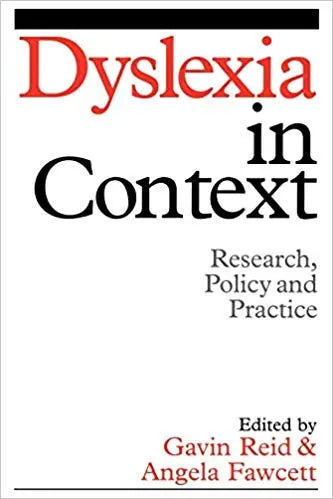
What it says on the back of the book
Edited by Gavin Reid PhD, University of Edinburgh and Angela Fawcett PhD, University of Sheffield
This book highlights the most recent developments in the area of research, policy and practice. All the authors are well-known in the field of dyslexia and they offered significant contributions at the BDA conference ���Dyslexia: the dividends from research to policy and practice��� at Warwick University in March 2004.
In addition to the opening chapter, which provides an overview of developments in dyslexia, there are also chapters on the research associated with neurological factors, the cerebellum, genetics, multilingualism and links between research and practice.
The policy section provides insights into policy developments from Continental Europe, the UK and the United States, as well as policy developments relating to both children and adults.
The practice section is comprehensive with chapters on the range of specific learning difficulties, ICT, mathematics, the implications for the classroom from the science of learning and the features of dyslexia-friendly schools.
An overview of developments in dyslexia Gavin Reid, Angela Fawcett
Part one: Research
- Introduction
- Dyslexia: the role of the cerebellum Angela Fawcett, Roderick Nicholson
- Developing flexible mapping in an inflexible system Aryan van der Leij
- Dyslexia genetics John Stein
- Brain-based assessment and instructional intervention Virginia W. Berninger
- The theory and practice of specialist literacy teaching John Rack
- Dyslexia and English as an additional language (EAL): towards a greater understanding Linda Seagull, Ian Smythe
Part two: Policy
- Introduction
- United Kingdom policy for inclusion Lindsay Peer
- Evidence-based reading policy in the US G. Reid Lyon, Sally E. Shaywitz, Vinita Chhabra, Robert Sweet
- Dyslexia and the workplace - policy for an inclusive society David McLaughlin
- Learning disability/dyslexia and employment: a US perspective Glenn Young, Jean Browning
- Dyslexia - early identification and early intervention Margaret Crombie, Deborah Knight, Gavin Reid
Part three: Practice
- Introduction
- The case for dyslexia friendly schools Neil Mackay
- Dyslexia-friendly schools - policy and practice Mike Johnson
- Learning from the science of learning: implications for the classroom Roderick Nicolson, Angela Fawcett
- Baseline assessment and the early identification of dyslexia Geoff Lindsay
- Dyslexic pupils and the key objectives of the National Numeracy Strategy Anne Anderson, Steve Chinn
- Using information and communication technology (ICT) to help dyslexic children Victoria Crivelli, Moira Thomson, Bodil Andersson
- The co-occurrence of specific learning difficulties: implications for identification and assessment Pamela Deponio.