

Autopress Education Ltd
Five-Spot Hungarian Number Frame - Pack of 10 Subitising Cards
Five-Spot Hungarian Number Frame - Pack of 10 Subitising Cards
SKU:TA2377
Couldn't load pickup availability


Autopress Education Five-Spot Hungarian Number Frame - Pack of 10 for Early Subitising
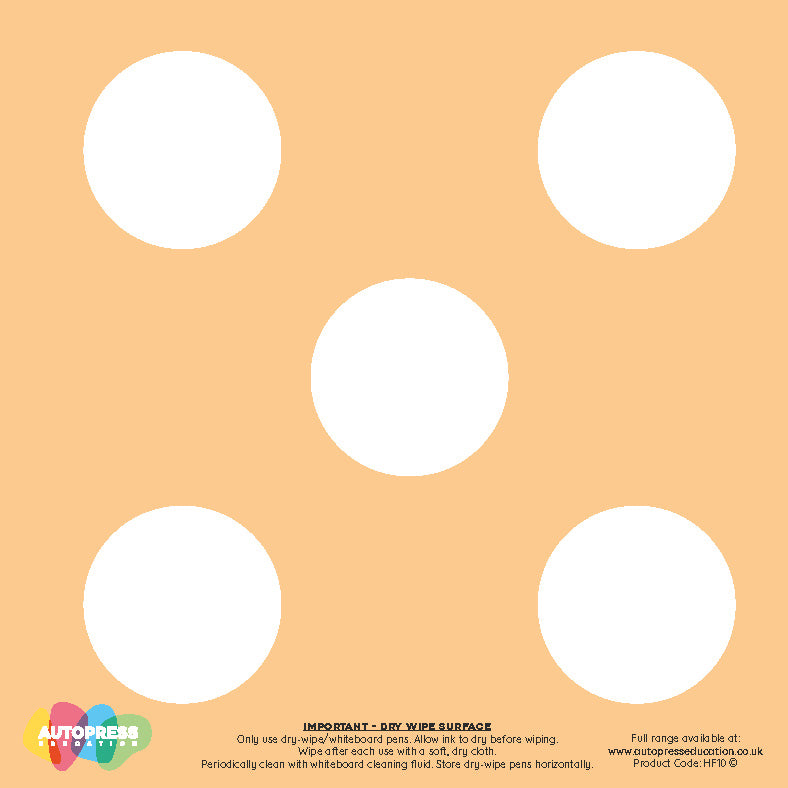
The Autopress Education Five-Spot Hungarian Number Frame is a compact, structured maths resource designed to develop early subitising skills for quantities from 0 to 5. This pack contains 10 individual square cards, each measuring 10cm x 10cm, with five spaces arranged in the five-spot dice pattern - the familiar layout of four dots at the corners and one in the centre. Each card can be used with counters or a dry wipe pen. Produced in the UK by Autopress Education, it is the entry-level product in the Autopress Hungarian Number Frame range and the most foundational subitising tool of the three.
Why Start with Five?
Before children can work confidently with numbers to 10 or 20, they need instant, reliable recognition of quantities from 1 to 5. This is not a small step - for many children, and particularly for those with dyscalculia, quantities even as small as 3 or 4 can require deliberate counting rather than immediate perception. The five-spot dice pattern is one of the most powerful tools for building this foundational recognition precisely because most young children already know it from play. They have seen the five-face of a die countless times, and their brain has already begun to associate that spatial pattern with the quantity five.
By working with a frame that uses exactly this familiar arrangement, pupils develop subitising for 1 to 5 - and all sub-arrangements within it (1, 2, 3, 4, 5 represented as specific patterns) - quickly and naturally. Once that recognition is automatic, the progression to the ten-frame (HF07) and twenty-frame (HF09) is built on genuinely secure foundations.
How It Helps
The five-spot frame is used to build and represent quantities from 0 to 5, and to explore how those quantities relate to each other. Placing counters in the spaces makes quantity visually concrete - a child can see at a glance that 3 is two corners and one centre, or that 4 is all four corners with the centre empty. The write-and-wipe surface allows the same activities with a dry wipe pen, supporting the transition from concrete manipulation to pictorial representation.
The compact 10cm x 10cm square format makes it easy for young children to handle, and for teachers to use quickly in whole-class or small-group settings without taking up much desk space. At £2.00 + VAT for a pack of 10, it is affordable for whole-class use in EYFS or for equipping a small intervention group.
Why It Works Well in Schools and Classrooms
- The most fundamental subitising tool in the range: instant recognition of quantities 1-5 is the bedrock of all number sense. This card builds that recognition using a pattern children already know from dice, making learning faster and more intuitive.
- Ideal for EYFS and early KS1: the small, square format (10cm x 10cm) is well suited to young children's hands and attention spans, and the five-space layout is appropriately sized for the earliest stages of number development.
- Entry point for dyscalculia support: for pupils with dyscalculia, subitising 1-5 reliably is often an area of specific difficulty. This card provides the most focused, least overwhelming starting point for building that foundational skill.
- Very low cost per card: at £2.00 + VAT for 10 cards (20p per card + VAT), this is the most economical of the three frame types, making whole-class provision in EYFS straightforward within any budget.
- First step in a coherent three-part progression: used before or alongside the ten-frame (HF07) and twenty-frame (HF09), the five-spot frame gives pupils a structured visual progression from subitising 0-5, to 0-10, to 0-20.
For Home Use
The five-spot frame is a compact, simple, and affordable home resource for parents supporting early maths learning, particularly for children with dyscalculia or those receiving early maths intervention. Each card is 10cm x 10cm - smaller than a postcard - making it easy to use on a kitchen table or carry in a bag. The dry wipe surface means it can be used repeatedly without needing counters.
The Evidence Behind Early Subitising
Subitising - instant visual recognition of quantity - is one of the earliest and most important mathematical skills a child develops, and is a strong predictor of later arithmetic attainment. The Education Endowment Foundation (EEF) identifies subitising as a key focus in early mathematics, and structured tools that build on familiar visual patterns such as dice faces are among the most effective ways to develop this skill. For pupils with dyscalculia, where subitising is often impaired even for small quantities, targeted visual tools at the 0-5 level provide the essential starting point for building numerical understanding from the ground up.
Ready to Order?
Add to your basket above. Each pack contains 10 cards. For use with counters or a dry wipe pen (both sold separately). Pairs with the Autopress ten-frame (HF07) and twenty-frame (HF09) for a complete 0-20 number sense progression.
- Five-spot dice pattern layout: five spaces arranged as four corners and one centre, mirroring the five-face of a standard die for instant subitising recognition
- Covers quantities 0-5: the entry-level product in the Autopress Hungarian Number Frame range, preceding the ten-frame (HF07) and twenty-frame (HF09) in the learning progression
- Square format: 10cm x 10cm per card - compact and easy for young children to handle
- Dual use: can be used with physical counters or with a dry wipe pen - supporting concrete and pictorial modes of working
- Pack of 10 cards
- SKU / Product Code: HF10
- Brand/Publisher: Autopress Education
- Supports: subitising 0-5, early number recognition, dyscalculia intervention at the foundational level
- Country of origin: United Kingdom
- What is the Autopress Five-Spot Hungarian Number Frame?
The Autopress Five-Spot Hungarian Number Frame (SKU: HF10) is a compact square card measuring 10cm x 10cm, with five spaces arranged in the five-spot dice pattern - four corners and one centre. It is used to develop subitising and early number recognition for quantities from 0 to 5. Each pack contains 10 cards, usable with counters or a dry wipe pen. It is the entry-level product in the Autopress Hungarian Number Frame range. - How is the Five-Spot Hungarian Number Frame different from the ten-frame (HF07) and twenty-frame (HF09)?
The five-spot frame (HF10) covers quantities 0-5 in a compact 10cm x 10cm square format and is the first step in the Autopress number frame progression. The ten-frame (HF07) covers 0-10 in a 21cm x 10cm rectangular format, and the twenty-frame (HF09) covers 0-20 in a 21cm x 20cm rectangular format. The five-spot frame is the most appropriate starting point for the youngest children or for pupils with dyscalculia who need to build subitising foundations at the most basic level before progressing. - Why use the five-spot dice pattern for a number frame?
The five-spot dice pattern - four dots at the corners and one in the centre - is one of the most familiar visual patterns children encounter through play. Because they have seen it many times on dice, their brain begins to associate that spatial arrangement with the quantity five before any formal teaching begins. Using the same pattern on a number frame allows subitising to develop naturally from existing recognition, making learning faster and more intuitive than a plain row or grid layout would allow. - Is the Five-Spot Frame suitable for pupils with dyscalculia?
Yes. For pupils with dyscalculia, subitising even small quantities such as 3 or 4 can require deliberate counting rather than instant perception. The five-spot frame provides the most focused starting point for developing that foundational recognition, targeting quantities 0-5 specifically with a familiar and intuitive visual pattern. It supports the concrete-pictorial-abstract progression that is central to dyscalculia intervention. - Can the Five-Spot Frame be used with counters and a dry wipe pen?
Yes. The card surface works with both physical counters placed in the spaces and a dry wipe pen used to draw marks directly on the card, supporting different stages of the concrete-pictorial-abstract learning progression. - Can the Five-Spot Frame be used at home?
Yes. At 10cm x 10cm, each card is small enough to use on a kitchen table, store in a pencil case, or carry easily. The dry wipe surface means it can be used repeatedly. It is a simple, low-cost starting point for parents supporting early number sense at home, particularly for children with dyscalculia.