
-
A4 -10mm Lined Tinted Exercise Book - (Yellow Cover)
Regular price From £2.65 GBPRegular priceUnit price per -
A4 Tinted Exercise Book, 7mm Lined - Visual Stress, Grey Cover
Regular price From £2.65 GBPRegular priceUnit price per -
A4 10mm Squared Tinted Exercise Book for Visual Stress - Blue Cover
Regular price From £2.65 GBPRegular priceUnit price per -
A4 7mm Squared Tinted Exercise Book for Visual Stress - Red Cover
Regular price From £2.65 GBPRegular priceUnit price per -
A4 8mm Lined Coloured Paper Refill Pad
Regular price From £4.00 GBPRegular priceUnit price per -
25 Sheets of A4 Coloured Paper Sheets 80gsm
Regular price £2.99 GBPRegular priceUnit price per -
9" x 7" - 10mm Lined Tinted Paper - Exercise Book (Yellow Cover)
Regular price From £2.56 GBPRegular priceUnit price per -
9" x 7" - 7mm Lined Tinted Paper - Exercise Book (Grey Cover)
Regular price From £2.56 GBPRegular priceUnit price per -
A3 80GSM Coloured Paper - Ream (500 Sheets)
Regular price £23.99 GBPRegular priceUnit price per -
A5 8mm Lined Coloured Paper Refill Pad
Regular price From £3.50 GBPRegular priceUnit price per -
9" x 7" - 7mm Squared Tinted Paper - Exercise Book (Red Cover)
Regular price From £2.56 GBPRegular priceUnit price per -
Tinted Paper Handwriting Exercise Book - 9"x7"
Regular price £2.56 GBPRegular priceUnit price per -
A4 - 8mm Lined Tinted Exercise Book (Red Cover)
Regular price From £2.75 GBPRegular priceUnit price per -
Twist 'n Write Pencils
Regular price From £9.95 GBPRegular priceUnit price per -
9" x 7" - 10mm Squared Coloured Paper Exercise Book
Regular price From £2.56 GBPRegular priceUnit price per -
A4 - Project Book - 10mm Lined and Plain on Alternate Page Tinted (Green Cover)
Regular price From £2.65 GBPRegular priceUnit price per







Frequently asked questions
What makes stationery dyslexia-friendly?
Paper colour, line guidance and grip. Cream or tinted paper reduces the glare that white paper causes for readers with visual stress. Guidelines support letter formation and size for pupils with dysgraphia. Pens and grips that need less pressure let a child write for longer without hand fatigue. The item itself is ordinary; the specification is what matters.
Does tinted or cream paper help with reading and writing?
It helps where visual stress is present, which is a distinct condition that often occurs alongside dyslexia rather than being part of it. Where a pupil describes glare, words shimmering or headaches after reading from white paper, tinted paper or exercise books frequently make an immediate difference. Where the difficulty is decoding or spelling, paper colour will not change it.
Which pens and pencils are best for a child who struggles with handwriting?
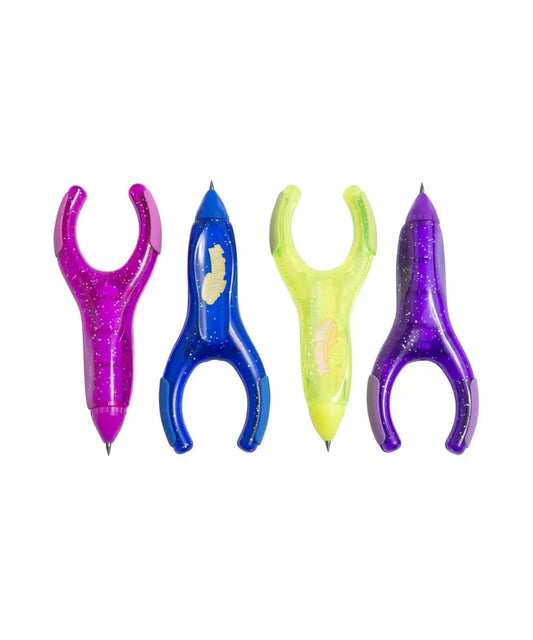
Look for a triangular or contoured barrel that positions the fingers into a tripod grip without the child having to think about it, and ink that flows with light pressure. For dyspraxia and dysgraphia, reducing the physical effort matters more than the brand. If a child is settled on a particular pencil, a foam or moulded grip achieves much the same result without a fight.
Are left-handed scissors worth buying?
Yes. Left-handed scissors have the blades reversed, so a left-handed user can see the cutting line and the natural squeeze closes the blades together rather than forcing them apart. Ordinary scissors used in the left hand tend to crumple paper, which children read as their own failure rather than a tool problem. Easy-grip and loop designs help further where fine-motor control is the difficulty.
What stationery does a child need for secondary school?
Pens, pencils, a rubber, a sharpener, a ruler, a protractor, a compass, a calculator and a pencil case cover the standard list. For a SEND pupil, add a reading ruler or overlay, tinted refill pads if glare is an issue, and spares of whichever pen actually suits them. Buying multiples of the right item is more useful than buying variety.
Can schools order stationery in bulk?
Yes. We supply schools, academies and multi-academy trusts, and we are used to helping SENCOs stock a SEND cupboard rather than simply filling a stationery order. If you are equipping several classrooms or building starter packs for pupils on SEN support, call us on 01394 671 818 and we will help you put a list together.
Do SEND pupils really need different stationery?
Not different, better specified. A dyspraxic pupil can use an ordinary pencil, but a contoured one costs the same and makes a full lesson of writing achievable. The purpose is to remove friction the pupil should not have to overcome, so effort goes into the work rather than into holding the pen. Most of these items suit any pupil, which is why they work well as whole-class provision.