


The Dyslexia Shop
Numerule - Counting Ruler for Dyscalculia & Numeracy
Numerule - Counting Ruler for Dyscalculia & Numeracy
SKU:ST805
Couldn't load pickup availability


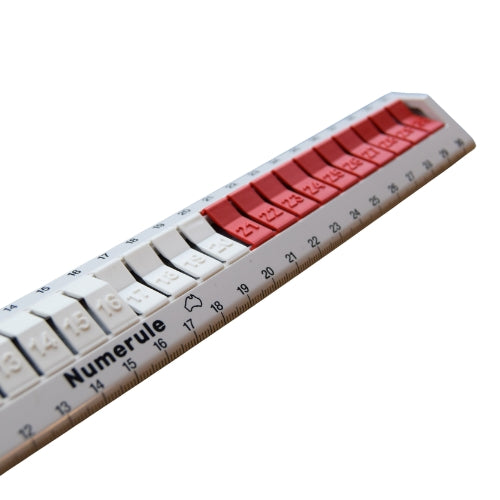
A multisensory way to build number sense
The Numerule is a multisensory counting ruler from Autopress Education, designed to help children who find numeracy difficult, including those with dyscalculia and other learning differences. By combining touch, sight and sound in one simple tool, the Numerule turns abstract number concepts into something children can physically feel and hear as they count.
Rather than relying on numbers on a page alone, the Numerule lets children press, feel and hear each number as they move along it. This concrete, kinaesthetic approach gives children a physical anchor for number sequences, which can make counting, number recognition and early number sense easier to grasp and easier to remember.
For schools
- A low-cost, durable resource that is easy to share across a class or small group during numeracy lessons.
- Supports Quality First Teaching and the graduated approach for pupils working towards numeracy targets in an EHCP or SEN support plan.
- Suitable for use in EYFS, KS1 and KS2 settings where concrete, hands-on maths resources are needed.
- Good value for bulk purchase by SENCOs, maths leads and local authority buyers building a multisensory maths toolkit.
For parents and home learning
- Gives parents a simple, screen-free way to support a child's counting and number confidence at home.
- Encourages children to explore numbers through touch and sound rather than through pressure to "get it right" on paper.
- Small and easy to keep in a school bag, pencil case or homework box for regular practice.
For children with dyscalculia, difficulty holding onto number sequences and understanding quantity can make everyday maths feel discouraging. The Numerule's combination of touch, sight and sound gives these children an extra sensory route into number, alongside the visual number line they see on paper. It is also a useful concrete resource for children with broader SEND or learning differences who benefit from hands-on, multisensory teaching rather than number work presented in the abstract alone.
Multisensory teaching approaches, which combine visual, auditory and kinaesthetic input, are widely used in specialist numeracy and literacy interventions in the UK because they give children more than one way to access and remember the same information.
The Numerule is a small, practical addition to any numeracy toolkit, whether it is used for five minutes at the kitchen table or as part of a structured intervention at school. Order yours from The Dyslexia Shop today to give a child a hands-on way into number sense.
- Multisensory design combining touch, sight and sound to support number recognition and counting.
- Concrete, physically interactive learning aid, ideal for kinaesthetic learners.
- Supplied as a single Numerule unit.
- Manufactured by Autopress Education, a UK supplier of concrete numeracy teaching resources.
- Turns numbers into something children can feel. The Numerule combines touch, sight and sound so children with dyscalculia get a physical, multisensory route into number sense.
- Works equally well at school and at home. Compact enough for a pencil case, sturdy enough for daily classroom use across a Reception, KS1 or KS2 group.
- A genuine concrete resource, not just a picture of one. Children handle real numbers rather than only seeing them printed on a page.
- Supplied by a UK numeracy specialist. Made by Autopress Education, a manufacturer focused on concrete maths teaching aids for schools and families.
Delivery and Returns
Standard UK delivery applies. See our Delivery and Returns page for full details.
- What is the Numerule and what does it do?
The Numerule is a multisensory counting ruler that combines touch, sight and sound to help children build number sense. It is a concrete, hands-on learning aid designed for kinaesthetic learners who benefit from physically interacting with numbers rather than only seeing them on paper. - Is the Numerule suitable for children with dyscalculia?
Yes, the Numerule is well suited to children with dyscalculia because it gives them a physical, multisensory way to build number sense. Combining touch, sight and sound alongside a visual number sequence can make counting and number recognition easier for children who find abstract number work difficult. - Can the Numerule help children with general SEND or learning differences?
Yes, the Numerule can support children with a range of SEND or general learning differences, not only dyscalculia. Its concrete, multisensory design suits any child who learns better through touch and hands-on practice rather than through numbers on a page alone. - How can teachers use the Numerule in the classroom?
Teachers can use the Numerule as a shared, hands-on numeracy resource during whole-class teaching, small-group intervention or one-to-one support. It is a low-cost addition to a multisensory maths toolkit and fits well within a Quality First Teaching or graduated approach for pupils on SEN support or an EHCP. - How can parents use the Numerule at home?
Parents can use the Numerule to support counting and number recognition practice at home in short, informal sessions. Its compact size makes it easy to keep in a school bag or homework box, so children can practise regularly without needing a worksheet or screen. - What age group is the Numerule suitable for?
The Numerule is designed for primary-age children who are learning to count and build number sense, broadly spanning EYFS to KS2 [UNVERIFIED - please check exact age range with the manufacturer]. It can also be used with older pupils who need continued concrete support with basic number concepts. - Does the Numerule need batteries or charging?
No, the Numerule is a mechanical, hands-on teaching aid and does not require batteries, charging or an app. Its sound and touch elements work through physical interaction alone, making it simple to use anywhere. - How is the Numerule different from a standard ruler or number line?
Unlike a printed number line, the Numerule adds a physical, interactive element that children can touch, press and hear as they count. This gives children an extra sensory channel for learning number sequences, on top of simply looking at printed numbers.