
-
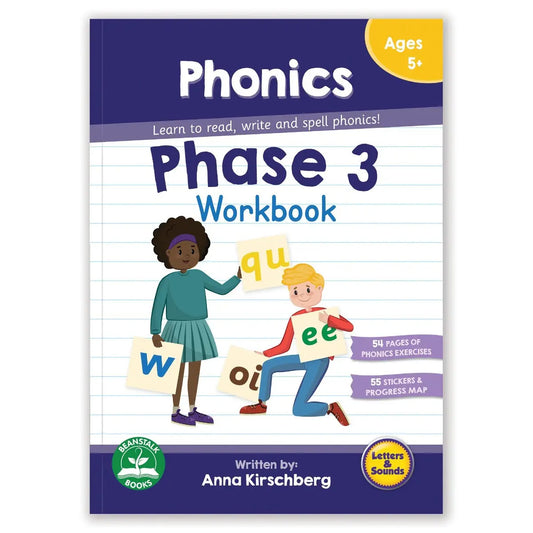
Phase 3 Phonics Workbook
Regular price £7.99 GBPRegular priceUnit price per -
Phase 5 Vowel Sounds Workbook
Regular price £7.99 GBPRegular priceUnit price per -
Phase 4 Blends Workbook
Regular price £7.99 GBPRegular priceUnit price per -
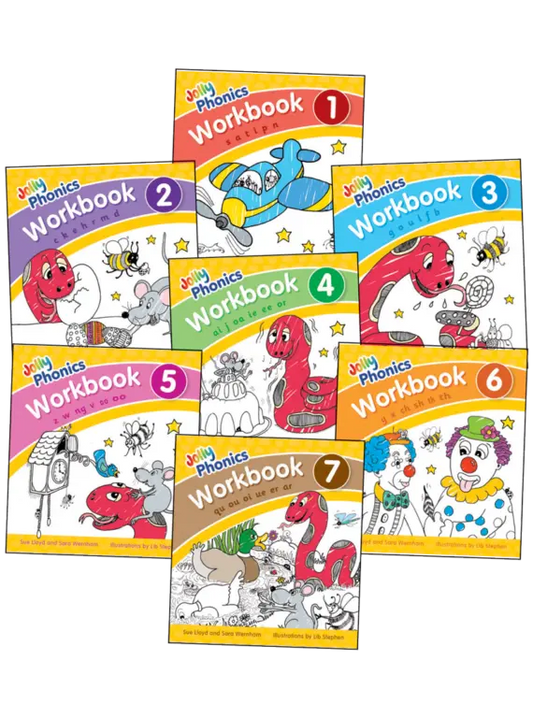
Jolly Phonics Workbook - Set of books 1 to 7
Regular price £17.15 GBPRegular priceUnit price per -
Phase 2 Letter Sounds Workbook
Regular price £7.99 GBPRegular priceUnit price per -
Phase 6 Spelling Workbook
Regular price £7.99 GBPRegular priceUnit price per -
Dandelion Readers Set 1 Units 1-10 'Sam'
Regular price £20.00 GBPRegular priceUnit price per -
Dandelion Readers - Units 11-20 (10 books) 'Pip Gets Rich'
Regular price £20.00 GBPRegular priceUnit price per -
Phase 1 Phonemic Awareness Workbook
Regular price £7.99 GBPRegular priceUnit price per -
Dandelion Readers - Units 1-10 (Set 2)
Regular price £20.00 GBPRegular priceUnit price per -
Jolly Phonics Workbook 1
Regular price £2.50 GBPRegular priceUnit price per -
Talisman Series, Series 1
Regular price £39.00 GBPRegular priceUnit price per -
Jolly Phonics Workbook 7
Regular price £2.50 GBPRegular priceUnit price per -
Moon Dogs Series, Set 1
Regular price £16.99 GBPRegular priceUnit price per -
Jolly Phonics Workbook 2
Regular price £2.50 GBPRegular priceUnit price per -
Jolly Phonics Workbook 6
Regular price £2.50 GBPRegular priceUnit price per




Frequently asked questions
What are phonics books?
Phonics books are reading books and workbooks built around letter sounds, so children can practise sounding out and blending words. The most useful type for early readers is the decodable reader, which only uses sounds and tricky words a child has already been taught. Series such as Jolly Phonics, Mog and Gom and Dandelion Readers follow a set order of sounds from simple CVC words onwards.
What phonics books are best for Reception?
The best phonics books for Reception match the early sounds taught in class, usually Phase 2 and Phase 3. Good starting points are the Phase 3 Mog and Gom Books, the first Jolly Phonics Workbooks, which begin with the sounds s, a, t, i, p and n, and DK 10 Minutes a Day Phonics for ages 3 to 5. Ask your child's teacher which sounds they are learning.
How can I help my child prepare for the Year 1 phonics screening check?
Read decodable books together little and often, and encourage your child to sound out unfamiliar words rather than guess from the pictures. GOV.UK suggests asking your child's teacher for books at the right phonics level. The check takes place in June, has 40 words including pseudo-words, and children who do not meet the standard retake it in Year 2.
When should children stop using decodable books?
There is no fixed age. Decodable books are designed to match the sounds a child has been taught, so they are most useful while a child is still learning the phonics code, typically through Reception, Year 1 and into Year 2. Once a child can decode new words accurately and fluently, they can move on to a wider range of books. Your child's teacher can advise.
What phonics books do schools use alongside their phonics programme?
Schools use decodable readers that follow the same order of sounds as their phonics programme, so pupils only read what they have been taught. Jolly Phonics is on the Department for Education's list of validated systematic synthetic phonics programmes, and we stock its pupil books, workbooks and class set. Classroom kits from Phonic Books suit guided reading and catch-up groups in Key Stage 1.
Are decodable books good for children with dyslexia?
Decodable books give children with dyslexia structured practice using only sounds they have been taught, so they can succeed without guessing. Around 1 in 10 people are dyslexic, according to the British Dyslexia Association, and many older pupils still have gaps in phonics. Phonic Books catch-up series such as Moon Dogs and Talisman combine decodable text with stories aimed at readers aged 8 to 14.