


ARK
ARK's Flower Wand Chewy - Handheld Sensory Chew Tool for Children
ARK's Flower Wand Chewy - Handheld Sensory Chew Tool for Children
SKU:TA2360-S-RED
Couldn't load pickup availability


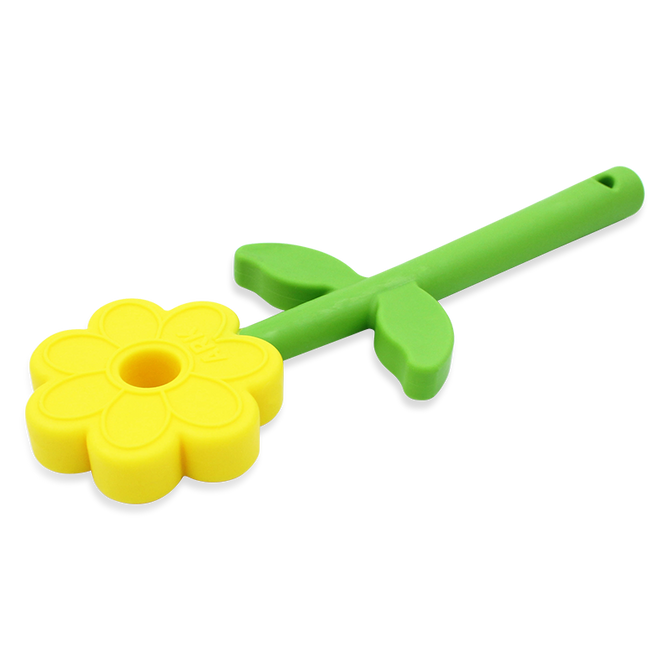
ARK's Flower Wand Chewy
ARK's Flower Wand Chewy is a handheld, dual-function sensory chew tool made from FDA-compliant, medical-grade elastomer by ARK Therapeutic in the USA. Shaped like a wand with a long, slender stem on one end and a wide flower on the other, it is one of the most versatile chew tools in the ARK range. The stem is designed for back molar chewing, which delivers deeper proprioceptive input through the jaw, while the flower end supports front teeth chewing for a lighter, more surface-level oral sensation. The flower end also features a raised rib around its outer edge, adding extra tactile and visual interest. This two-in-one design means a single tool can support a broader range of oral sensory preferences than many single-shape chews.
How It Helps
Chewing is a recognised self-regulation strategy supported by sensory integration therapy and widely used by occupational therapists working with children with autism, ADHD, sensory processing differences, dyspraxia, and anxiety. The proprioceptive input generated through the jaw muscles during chewing has a calming and organising effect on the central nervous system, helping to reduce anxiety, improve focus, and support emotional regulation. For children who habitually chew clothing, pencils, fingers, or other objects, the ARK Flower Wand Chewy provides a safe, hygienic, and purpose-built alternative that can be used at home, in school, or in a therapy setting.
Unlike pencil toppers, which are paired with a specific writing tool, the Flower Wand is a fully handheld chew. This makes it well suited for use outside of writing tasks - during circle time, transitions, sensory breaks, travel, or any situation where a child needs oral sensory input but does not have a pencil to hand. The wand format also makes it intuitive and appealing for younger children, particularly those aged 3 to 7, who may engage more readily with a toy-like object than with a more clinical-looking tool.
Why It Works in Schools and Classrooms
- Dual-function design suits a wider range of oral sensory needs: the long stem supports back molar chewing for deeper input, whilst the flower end supports front teeth chewing for milder input, reducing the need to trial multiple tools to find the right match for a pupil's preference.
- Suitable from age 3 and appropriate across EYFS and KS1: the Flower Wand Chewy can be introduced earlier than pencil toppers, making it a practical first chew tool for younger pupils in nursery, Reception, and Year 1 who are beginning to display oral sensory seeking behaviours.
- Three firmness levels support individualised SEN provision: SENCOs and occupational therapists can select or trial the appropriate resistance level for each pupil as part of a sensory diet, EHCP provision, or oral motor intervention plan.
- Useful beyond the writing table: as a handheld tool, the Flower Wand can be used during any part of the school day - carpet sessions, group activities, sensory breaks, or transition times - broadening the range of contexts in which oral sensory support can be provided.
- Easy to clean and maintain: top-rack dishwasher safe, making it straightforward to uphold hygiene standards in a school or nursery environment.
For Home Use
At home, the Flower Wand Chewy is a practical tool for any time a child needs to chew - whether during homework, screen time, meals, or play. Its appealing flower and wand shape tends to be well accepted by younger children who might resist more obviously therapeutic-looking tools. Parents and carers can offer it as a calm, normalised part of daily routine rather than as a reactive response to difficult behaviour.
The Research Behind Oral Sensory Input
Oral motor input, including chewing, is a core component of sensory integration therapy. Proprioceptive feedback through the jaw has a documented calming and organising effect on the central nervous system, and chewable tools are routinely recommended by occupational therapists as part of a sensory diet for children with autism, ADHD, dyspraxia, or anxiety. The British Dyslexia Association (BDA) recognises that dyslexia frequently co-occurs with conditions such as dyspraxia and ADHD, and many children in dyslexia support programmes also benefit from sensory regulation tools as part of a broader approach to supporting learning. The ARK Flower Wand Chewy provides a practical, portable, and engaging way to deliver this support across a range of settings.
If you are unsure whether this product is right for a particular child, or which firmness level to choose, an occupational therapist or SENCO will be best placed to advise. As a general rule, start at the Standard level and move up only if it is not providing sufficient resistance.
- Two-in-one handheld chew tool: long stem on one end for back molar chewing (deeper proprioceptive input); wide flower shape on the other end for front teeth chewing (lighter oral sensation).
- Ribbed outer edge on flower end: a raised rib around the outside of the flower provides additional tactile and visual interest for children who enjoy extra sensory input.
- Two-toned design: the flower petals and stem are moulded in contrasting colours for visual appeal and easy identification of the two functional ends.
- Medical-grade elastomer construction: FDA compliant and free from lead, phthalates, PVC, BPA, and latex - safe for oral use.
- Dimensions: 6.4 inches (approximately 163 mm) long; 2 inches (approximately 51 mm) across the widest part of the petals; petals are 0.5 inches (approximately 12.7 mm) thick; stem is 0.5 inches (approximately 12.7 mm) in diameter.
- Three colour-coded firmness levels: Standard (softest, for mild chewers - Red, Yellow, Light Pink); XT - Extra Tough (medium firmness, for moderate chewers - Hot Pink, Bright Blue); XXT - Extra Extra Tough (firmest, for avid chewers - Royal Blue, Lavender).
- Age suitability: recommended for children aged 3 years and above. Adult supervision required at all times.
- Cleaning: handwash or top-rack dishwasher safe.
- Sold individually: each Flower Wand Chewy is sold as a single item; no pencil included.
- Made in the USA by ARK Therapeutic, Columbia, South Carolina.
- What is ARK's Flower Wand Chewy?
ARK's Flower Wand Chewy is a handheld, two-function sensory chew tool made from FDA-compliant, medical-grade elastomer by ARK Therapeutic in the USA. It features a long stem for back molar chewing and a wide flower shape for front teeth chewing, making it one of the most versatile chew tools in the ARK range. It is suitable for children aged 3 and above who need oral sensory input to self-regulate, and is available in three firmness levels. - How is the Flower Wand Chewy different from a chewable pencil topper?
The Flower Wand Chewy is a fully handheld chew tool, not attached to a pencil. This means it can be used at any point in the day - during carpet sessions, transitions, sensory breaks, or at home - rather than only during writing tasks. It is also suitable from age 3, which is younger than ARK's pencil toppers (which are recommended from age 6). Its dual-ended design also means a single tool can support both back molar and front teeth chewing preferences. - Who is the ARK Flower Wand Chewy suitable for?
The ARK Flower Wand Chewy is suitable for children aged 3 and above, teenagers, and adults who have oral sensory needs. It is widely used with children with autism, ADHD, sensory processing differences, dyspraxia, or anxiety, and is appropriate for use in nurseries, primary schools, secondary schools, therapy settings, and at home. Its engaging flower and wand shape makes it particularly well suited to younger children in EYFS and KS1. - What is the difference between back molar chewing and front teeth chewing?
Back molar chewing, supported by the long stem end of the Flower Wand, engages the rear jaw muscles and delivers stronger, deeper proprioceptive input. This tends to be more calming and organising for the nervous system. Front teeth chewing, supported by the wide flower end, engages the front of the mouth for a lighter sensation. Some children prefer one over the other, and some alternate between the two depending on their needs at a given moment. Having both options in a single tool makes it easier to meet a child's preference without needing multiple products. - How does chewing help children with autism or sensory processing difficulties?
Chewing provides proprioceptive input through the jaw muscles, which has a calming and organising effect on the central nervous system. For children with autism, ADHD, sensory processing differences, or anxiety, this oral sensory input can reduce distress, improve focus, and support self-regulation. Occupational therapists frequently include chewable tools in a child's sensory diet as a practical, low-barrier strategy that can be used across multiple settings throughout the day. - Which firmness level should I choose for my child?
Standard is the softest level and is recommended as a starting point, particularly for younger children aged 3 to 5 or for mild chewers. XT (Extra Tough) suits moderate chewers who sometimes chew through softer items. XXT (Extra Extra Tough) is the firmest level and is designed for avid chewers. If in doubt, begin at Standard and move up only if the child appears to find insufficient resistance or chews through it quickly. - Is the ARK Flower Wand Chewy safe for nursery and primary school use?
Yes. The ARK Flower Wand Chewy is made from medical-grade elastomer that is FDA compliant and contains no lead, phthalates, PVC, BPA, or latex. It is top-rack dishwasher safe, supporting hygiene in early years and school environments. Adult supervision is required at all times, and the tool should be regularly inspected and replaced at the first sign of wear and tear. - Can the ARK Flower Wand Chewy be used as part of a sensory diet or EHCP?
Yes. Handheld chew tools such as the ARK Flower Wand Chewy are commonly recommended by occupational therapists as part of a sensory diet or oral motor intervention plan. The dual-function design and three firmness levels make it a flexible tool that can be tailored to individual needs, and its engaging shape is particularly helpful for introducing chew tools to younger children who might be reluctant to use more clinical-looking alternatives.