

Jessica Kingsley Publishers
Building Social Awareness in Autistic Children and their Peers Using Minecraft® : A Step by Step Guide to Running Neurodiversity-Affirming Groups (Revised Edition)
Building Social Awareness in Autistic Children and their Peers Using Minecraft® : A Step by Step Guide to Running Neurodiversity-Affirming Groups (Revised Edition)
SKU:BK2556
Couldn't load pickup availability


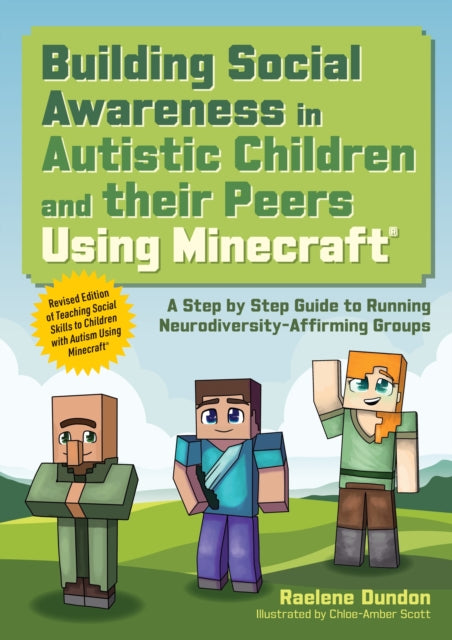
Children who find social interaction difficult often find it easier when there is something to do together. Minecraft® — familiar, motivating, and endlessly flexible — turns out to be a remarkably effective tool for building exactly the kind of shared experiences that help children develop social awareness. Building Social Awareness in Autistic Children and their Peers Using Minecraft® by Raelene Dundon is the fully revised and updated edition of her widely used practitioner guide, now rewritten to reflect current neurodiversity-affirming thinking.
What this book covers
This manual provides a complete, step-by-step framework for setting up and running a Minecraft Social Group. Each session plan focuses on a different aspect of social development — including cooperation, persistence, perspective-taking, and accepting difference — with the goal of helping children build skills they can carry into the playground and beyond. The programme is designed to work for mixed groups of autistic children and their neurotypical peers, reflecting the understanding that social interaction is a two-way process.
This revised edition has been thoroughly updated with neuro-affirmative language throughout, and introduces an age-appropriate exploration of the double empathy problem — the principle that communication challenges between autistic and non-autistic people are not a deficit in one party, but a shared responsibility on both sides. This is a meaningful shift from earlier social skills approaches, and one that will resonate strongly with professionals working in inclusive settings.
Why it works in schools and clinical settings
- Ready to run from day one — with over 100 pages of downloadable session plans and handouts included, this is a true turnkey resource that minimises preparation time and makes it practical to deliver consistent, structured groups.
- Inclusive by design — the programme supports autistic children alongside their peers, not in isolation, making it suitable for mainstream schools and inclusion-focused settings. It builds shared understanding, not just skills in one group.
- Rooted in current neurodiversity-affirming practice — the double empathy framework and updated language reflect where the field has moved, making this edition appropriate for practitioners who want their work to align with contemporary best practice on autism and social development.
- Highly motivating for children — Minecraft is one of the most widely played games in the world. Using it as the vehicle for group work removes the performance anxiety that structured social activities can create, giving children a genuine reason to engage.
- Written by a practitioner with lived experience — Raelene Dundon is a late-diagnosed Autistic ADHDer, an Educational and Developmental Psychologist, and a Play Therapist with over 20 years of experience. Her understanding of the work is both professional and personal.
Who it is for
This guide is primarily for professionals — educational psychologists, speech and language therapists, SENCOs, play therapists, and specialist teachers — who work with groups of children in school or clinical settings. It is practical rather than theoretical, and requires no prior expertise in Minecraft beyond a willingness to learn alongside the children.
Ready to explore?
If you are looking for a structured, evidence-informed group programme that meets children where they already are, this revised edition is well worth a close look. Contact our team if you would like to discuss whether it is right for your setting.
- Fully revised edition — updated throughout with neuro-affirmative language and principles, including an accessible introduction to the double empathy problem.
- Complete group programme — step-by-step session plans covering cooperation, persistence, perspective-taking, communication, and accepting difference.
- Over 100 pages of downloadable resources — session plans and handouts available to download, making delivery straightforward for busy practitioners.
- Inclusive design — programme supports autistic children and their neurotypical peers together, reflecting the principle that social awareness is a shared responsibility.
- Endorsed by Professor Tony Attwood, Clinical Psychologist specialising in autism for over 50 years.
- Author credentials — Raelene Dundon is a late-diagnosed Autistic ADHDer, Educational and Developmental Psychologist, Play Therapist, and Director of Okey Dokey Childhood Therapy in Melbourne, Australia. She lectures in Play Therapy at Deakin University and has over 20 years of clinical experience.
- Illustrated by Chloe-Amber Scott and Jessica Scott.
- Format: Trade Paperback
- Pages: 272
- Dimensions: 294 x 210mm
- Publisher: Jessica Kingsley Publishers
- Published: 21 January 2026
- Do I need to know how to play Minecraft to use this programme?
No prior expertise in Minecraft is required. The guide introduces the game in a practical way and provides enough background for any professional to set up and facilitate the sessions. Many practitioners find they learn alongside the children, which can itself be a useful dynamic in the group. - What age range is the programme designed for?
The programme is primarily designed for primary school-aged children, broadly suited to ages 5–12. It works best for children attending mainstream school who are autistic or have social communication differences, along with their neurotypical peers. - What equipment is needed to run a Minecraft Social Group?
You will need access to devices (tablets, computers, or consoles) with Minecraft installed, set up to allow children to play in the same world together. The guide provides practical advice on the technical setup required. Schools and clinics that already have devices available will find the resource straightforward to implement. - How does this revised edition differ from the original?
The revised edition has been comprehensively updated to reflect current neurodiversity-affirming thinking. This includes revised language throughout, a reworked framework that moves away from deficit-based approaches, and the introduction of the double empathy problem — the principle that social communication is a shared responsibility, not a deficit in autistic individuals alone. - Is this suitable for use in mainstream schools as well as specialist settings?
Yes. The programme is designed to include both autistic children and their neurotypical peers, making it well suited to mainstream schools where inclusion is a priority. It is also used in specialist and clinical settings by educational psychologists, speech and language therapists, and play therapists. - Can schools order this in bulk?
Yes. The Dyslexia Shop offers purchase orders and 30-day credit accounts for schools and educational organisations. Please contact sales@thedyslexiashop.co.uk to discuss bulk orders or school account arrangements.