

Jessica Kingsley Publishers
The Autistic Teen Girl's School Survival Guide
The Autistic Teen Girl's School Survival Guide
SKU:BK2555
Couldn't load pickup availability


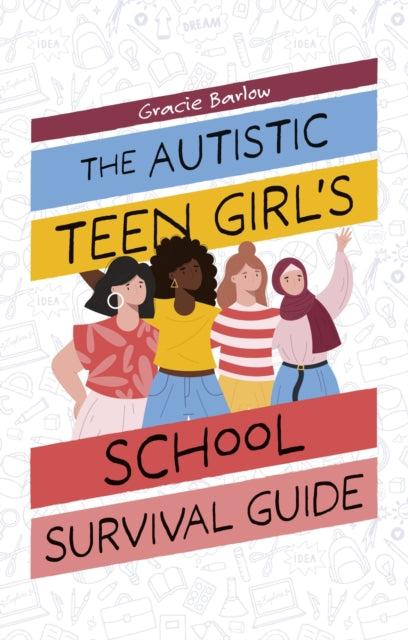
For many autistic girls, secondary school involves far more than just learning — it means navigating sensory overload, decoding confusing social situations, managing the exhausting work of masking, and doing it all largely unseen. The Autistic Teen Girl's School Survival Guide by Gracie Barlow was written to change that.
Gracie was diagnosed autistic at 15 and spent her school years doing what many autistic girls do: blending in, people-pleasing, and getting by. Now a writer and actor with a first-class degree from UEA, she has written the guide she wishes she had — one that is honest about how hard school can be, and practical about what actually helps.
What this book covers
The guide is written directly to autistic teenage girls, covering the parts of school life that are rarely addressed in mainstream resources: understanding yourself better, communicating your needs, making and keeping friends, staying safe, and managing the mental health challenges that can come with being neurodivergent in a neurotypical world. There is also guidance for when the time comes to move on — with advice on work and further study so readers do not have to face those transitions alone.
The book also has relevance for young people with co-occurring ADHD, reflecting Gracie's own experience of receiving an additional ADHD diagnosis after her autism diagnosis.
Why schools and SENCOs should have this on the shelf
- Written by someone with lived experience — Gracie Barlow is autistic, ADHD, and was a secondary school student herself. This is not a clinical text or a professional's interpretation of autism; it is an insider account that autistic students can genuinely see themselves in.
- Bridges the gap between student and school — the book includes practical suggestions for how schools and families can make small adjustments, making it useful as a conversation tool between students, parents, and staff.
- Addresses the specific experience of autistic girls — autism in girls and women has historically been underdiagnosed and underserved by resources. This book fills a real gap in SEN provision for female students and supports schools in meeting a need that is increasingly recognised but still poorly resourced.
- Short, accessible, and designed to be read independently — at 119 pages, this is a book students can pick up and read themselves, in one sitting or in sections, without it feeling like work.
- Endorsed by leading voices in autism education — recommended by both a headteacher of a specialist autism school and a senior academic at Sheffield Hallam University, giving schools confidence in its quality and relevance.
For parents too
Parents of autistic teenage daughters will find this book genuinely illuminating. Reading it alongside their child — or before a difficult conversation — can help build understanding of experiences that are easy to misread from the outside.
Take a look
If you support autistic girls in school or at home, this is the kind of resource that can make a real difference. Have a browse, or contact our team if you'd like to discuss whether it's right for your setting.
- Written by an autistic author with lived experience — Gracie Barlow was diagnosed autistic at 15 and ADHD subsequently, bringing both personal insight and credibility to the content.
- Covers key secondary school challenges — including sensory overload, social communication, masking, making friends, personal safety, and mental health.
- Includes guidance for transitions — advice on navigating life after school, including work and further study.
- Relevant for students with co-occurring ADHD — the guide addresses neurodivergent mental health challenges beyond autism alone.
- Includes practical suggestions for schools and families — not just for the student, but a resource that supports conversations between young people, parents, and professionals.
- Endorsed by Dr Luke Beardon, Senior Lecturer in Autism at Sheffield Hallam University, and Sarah Wild, Headteacher of Limpsfield Grange School.
- Format: Paperback
- Pages: 119
- Publisher: Jessica Kingsley Publishers
- Published: 21 February 2025
- Age suitability: Secondary school age (approximately 11–18), parents, and school staff
- Is this book suitable for someone who hasn't been formally diagnosed?
Yes. Many autistic girls go undiagnosed or receive a late diagnosis. The experiences described in the book — masking, sensory sensitivity, social confusion — will resonate with many readers who are questioning or self-identifying, not only those with a formal diagnosis. - Is this written for the student to read themselves, or for adults to read about them?
It is written directly to the student, in Gracie's own voice and from her own experience. That said, parents, teachers, and SENCOs consistently report finding it highly valuable for understanding what autistic girls go through at school — it is genuinely useful for both audiences. - Does it address ADHD as well as autism?
Yes. The book includes guidance relevant to those with co-occurring ADHD and the mental health challenges that can come with being neurodivergent more broadly. This reflects Gracie's own experience of receiving an additional ADHD diagnosis. - How long is the book — will a reluctant reader manage it?
At 119 pages, it is deliberately concise. It is designed to be accessible to students who struggle with longer texts, and can be read in a single sitting or dipped into by chapter. - Can schools purchase this in bulk?
Yes. The Dyslexia Shop accepts purchase orders and offers 30-day credit accounts for schools and educational organisations. Please email sales@thedyslexiashop.co.uk to discuss bulk orders. - Is this book only for girls, or would non-binary and gender-diverse autistic young people find it relevant?
The book is written from the perspective of an autistic girl and the language reflects that, but many of the experiences described — masking, sensory challenges, navigating social situations — will resonate more broadly with autistic young people of different gender identities who have been socialised in similar ways.